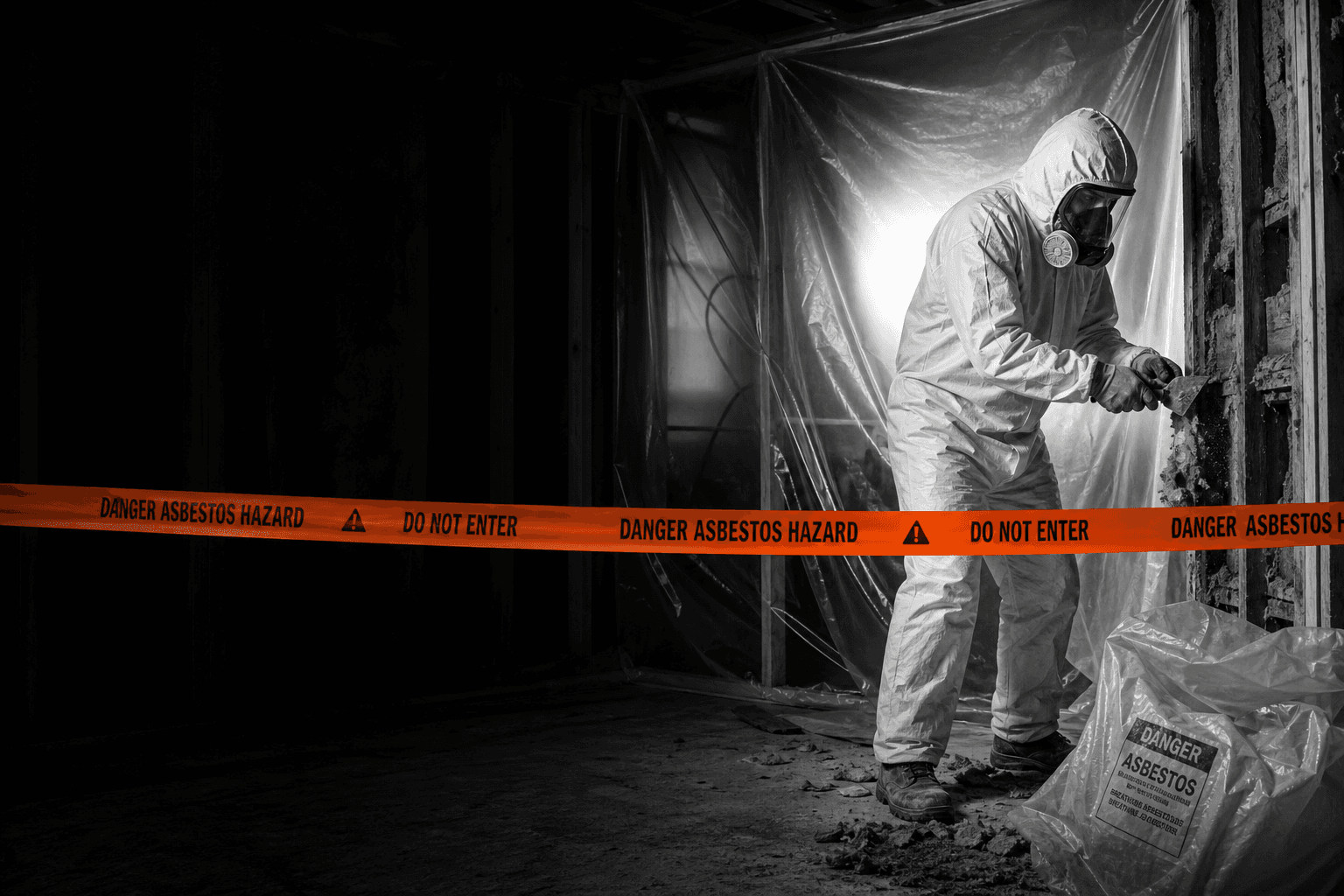
Surrey, BC · WorkSafeBC Compliant · Licensed & Insured
Asbestos Removal
Surrey,
Done Right
Surrey Asbestos Removal Pros provide safe testing, containment and asbestos removal so Surrey homeowners can renovate and breathe easy.
- WorkSafeBC Compliant
- Accredited Lab Testing
- Certified Safe Disposal
- Local to Surrey
Start here
Think your Surrey home has asbestos?
If your Surrey property predates the early 1990s, testing is the safe first step. Tell us what you're dealing with and we'll take it from there.
- Free, no-obligation assessment
- Accredited lab testing, clear written results
- Sealed containment and HEPA-filtered removal
- Certified disposal with full documentation
Surrey, BC
Surrey's trusted residential asbestos removal & testing team
If your Surrey home or building went up before the early 1990s, there's a real chance asbestos is hiding inside it. It shows up in popcorn ceilings, vinyl flooring, drywall mud, attic insulation, pipe wrap and more. Left alone it's usually fine. The danger starts the moment you cut, sand or tear into it during a renovation, because that's when the fibres go airborne.
That's where we come in. Surrey Asbestos Removal Pros provides licensed asbestos testing and removal across Surrey and the Lower Mainland. We sample suspect materials safely, confirm the results with an accredited lab, and if asbestos is found, we remove it under sealed containment with HEPA-filtered air. Every job follows WorkSafeBC procedures, and every scrap of waste goes to a certified disposal facility with the right paperwork.
Whether it's a single textured ceiling in a Newton bungalow, vermiculite insulation in a Cloverdale attic, or a full pre-demolition survey in Guildford, we handle it the right way. No scare tactics, no mess left behind, just safe work and a clear path so you can renovate with confidence. Call us for a quote and we'll walk you through exactly what your project needs.
What we do
Residential asbestos removal & abatement services in Surrey, BC
Asbestos testing and removal, plus flood restoration, water damage drying, and mold testing and remediation across Surrey and the Lower Mainland.
Asbestos Testing & Inspection
On-site sampling and accredited lab testing so you know exactly what you're dealing with before any work starts.
Learn more02Residential Asbestos Removal
Full containment removal for houses, townhomes and condos so your family can renovate and breathe easy.
Learn more03Commercial Asbestos Removal
Abatement for offices, retail, schools and multi-unit buildings, done to WorkSafeBC standards with minimal downtime.
Learn more04Popcorn Ceiling Removal
Many textured ceilings sprayed before 1990 contain asbestos. We test, contain and remove them safely.
Learn more05Vermiculite Insulation Removal
Old vermiculite attic insulation can contain asbestos. We remove it with HEPA vacuums and sealed containment.
Learn more06Asbestos Floor Tile & Lino Removal
Old vinyl tile, sheet flooring and the black mastic underneath often contain asbestos. We remove it without spreading fibres.
Learn more07Drywall & Joint Compound Removal
Pre-1990 drywall mud and texture frequently test positive. We remove walls and ceilings under proper containment.
Learn more08Pre-Demolition Abatement
Surrey requires a hazardous materials survey before demolition. We handle the survey and full abatement so your project stays on schedule.
Learn more09Air Quality & Clearance Testing
Independent air sampling after removal so you have written proof the space is safe to re-occupy and renovate.
Learn more10Asbestos Abatement
WorkSafeBC-compliant abatement for contractors, developers and strata — covering removal, encapsulation and full regulatory documentation.
Learn more11Asbestos Remediation
When asbestos has already been disturbed, we contain the problem, decontaminate the space and restore it to a documented safe condition.
Learn more12Flood Restoration
Emergency water extraction and structural drying after a flood, storm surge, sewage backup or a failed sump.
Learn more13Mold Testing
Moisture mapping plus air and surface samples, sent to a lab, so you know if mold is actually there before anyone opens a wall.
Learn more14Mold Removal & Remediation
Contained removal of moldy materials, HEPA cleaning, and drying so the growth is gone and it doesn't come straight back.
Learn more15Water Damage Restoration
Burst pipes, appliance leaks and roof leaks. We extract the water, dry the structure, and document it before mold gets a start.
Learn moreWhy Surrey homeowners call us
Surrey's asbestos abatement specialists
Asbestos work isn't the place to cut corners. Here's what you get from a local, licensed Surrey asbestos removal crew.
Local Surrey crews
We're based right here in the Lower Mainland and know Surrey's housing stock, permit process and disposal sites inside out.
Strict containment & HEPA filtration
Every job uses sealed containment and HEPA-filtered air so fibres never spread to the rest of your home or building.
WorkSafeBC-compliant procedures
BC has some of the strictest asbestos rules in the country. We follow them to the letter so you stay on the right side of the regulations.
Accredited lab testing
Samples go to an accredited lab, and clearance air testing is done independently so the results actually mean something.
Safe, certified disposal
All asbestos waste is bagged, sealed and taken to certified disposal facilities with the proper paperwork.
Straightforward and clear
We tell you what we find, what needs to happen and what to expect, in plain language with no scare tactics.
How it works
How our Surrey residential asbestos abatement works
No guesswork and no scare tactics. Here's exactly how an asbestos abatement job runs.
- 01
On-site assessment & sampling
We come out, look at the material, and take samples of anything we suspect contains asbestos.
- 02
Accredited lab testing
Samples go to a certified lab. You get a clear answer on what is and isn't asbestos before any removal happens.
- 03
Sealed containment & removal
We build proper containment, run HEPA-filtered negative air, and remove the material without spreading fibres.
- 04
Safe disposal
Everything is double-bagged, sealed and hauled to a certified disposal facility with full documentation.
- 05
Clearance testing
Independent air testing confirms the space is clean, and you get written clearance so you can renovate with confidence.
The Science & Process
What asbestos testing & removal actually involves
Asbestos work is regulated, technical and unforgiving when done wrong. Here's a plain-language breakdown of the science, the materials and the process from sampling through to clearance.
The Six Regulated Asbestos Minerals
Chrysotile (white asbestos) accounts for over 90% of positive test results in BC homes. Amosite (brown) and crocidolite (blue) are less common but more potent. The other three regulated types — tremolite, actinolite and anthophyllite — turn up in insulation and vermiculite. All six are regulated under BC's OHS Regulation because all six cause mesothelioma, asbestosis and lung cancer when inhaled as fine fibres.
Friable vs Non-Friable ACM
A material is friable when it can be crumbled by hand pressure, releasing fibres into the air. Popcorn ceiling texture, pipe lagging and spray-applied acoustic insulation are classic friable materials. Vinyl floor tile and asbestos-cement panels are non-friable when intact, but cutting, grinding or demolishing them makes them friable. WorkSafeBC regulations assign different work-type classifications — and different control measures — based on this distinction.
Bulk Sampling & PLM Laboratory Analysis
We collect 2-5 gram bulk samples from suspect materials using full containment procedures. These go to an accredited laboratory where a polarised light microscopy (PLM) analyst identifies fibre type and estimates concentration. A material is legally considered asbestos-containing at 0.5% or greater under BC's OHS Regulation. Results are typically back in 2-5 business days, with 24-hour rush turnaround available when a project is on a tight schedule.
WorkSafeBC Type 1, 2 & 3 Work Classifications
BC regulations classify asbestos removal into three types based on the quantity and condition of the material. Type 1 covers minor low-disturbance work on small areas. Type 2 involves more significant disturbance of friable or non-friable ACM and requires full PPE and containment. Type 3 is large-scale work on friable materials and mandates a sealed poly enclosure with negative air pressure and a licensed decontamination unit. We're trained and equipped for all three.
Containment, Negative Air & Decon Units
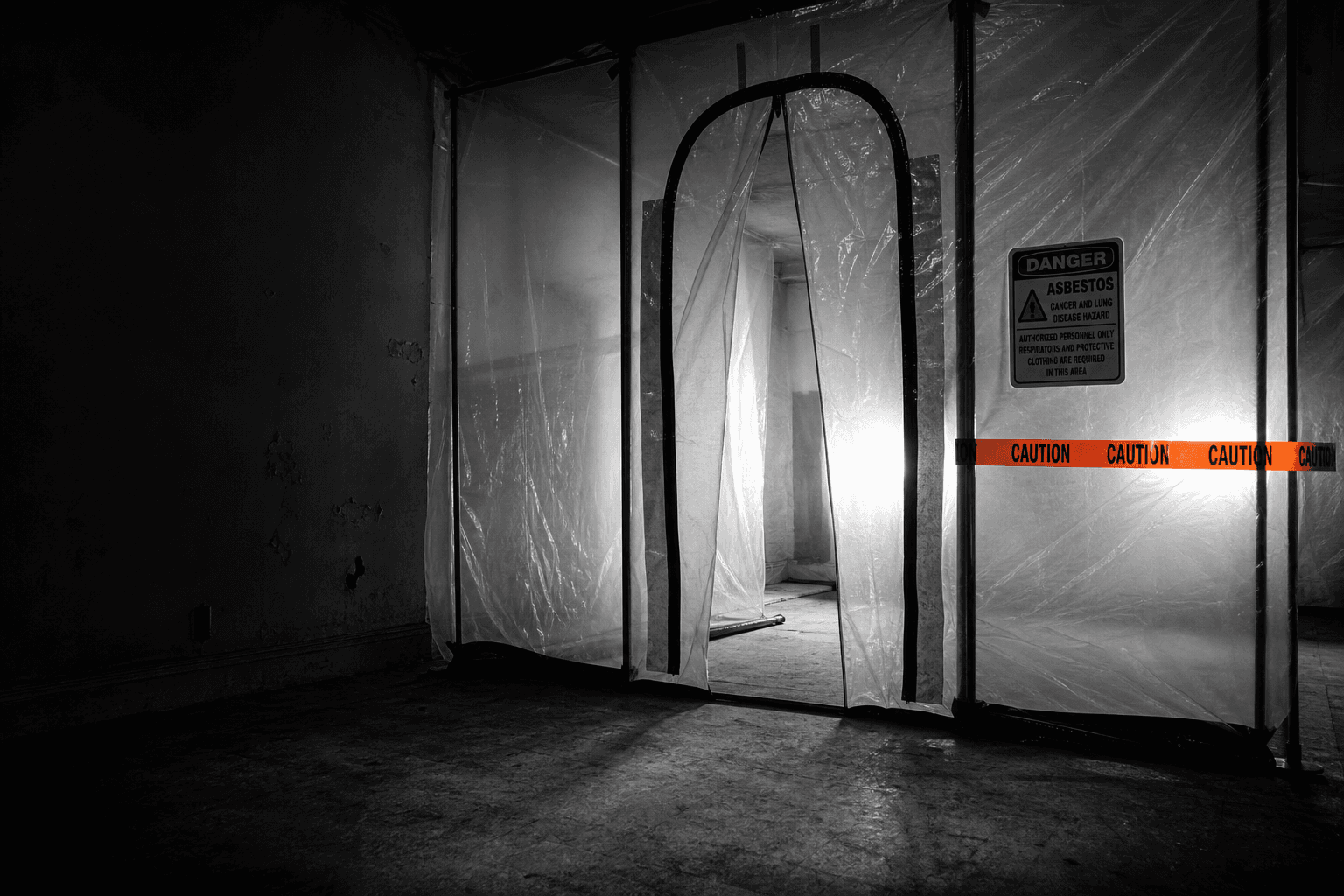
Type 2 and 3 removals are performed inside a sealed poly-sheeting enclosure with critical barriers at all penetrations. A HEPA-filtered negative-air machine exhausts air out of the containment while drawing clean replacement air in, keeping pressure negative so fibres can't migrate to the rest of the building. Workers enter and exit through a three-stage decontamination unit. The enclosure stays up until air clearance testing confirms the space is clean.
Air Clearance Testing & Certified Disposal
After removal, phase contrast microscopy (PCM) air testing confirms fibre counts are below the WorkSafeBC clearance threshold before the enclosure comes down and the space is released. All asbestos waste is double-bagged in labelled 6-mil poly bags, placed in sealed containers and transported to a certified BC hazardous-waste facility. A consignment manifest documents the chain of custody from our hands to the disposal site. You receive copies of every piece of documentation.
Where asbestos hides in a typical BC home
Our Work
The projects we handle across Surrey & the Lower Mainland
Every asbestos job is different. Here's a breakdown of the project types we work on most, what each involves and what it takes to do them right.
Pre-Renovation Testing & Survey
This is the most common job we do. Before a kitchen gut, bathroom update, basement finishing or any wall work in a pre-1990 home, we come in and sample every suspect material in the renovation scope. You get lab-confirmed results and know exactly what you're dealing with before your contractor lifts a hammer. WorkSafeBC requires this step, and it prevents the far more expensive scenario of discovering asbestos mid-renovation.
Popcorn & Textured Ceiling Removal
Textured acoustic ceilings, the stipple and popcorn finishes applied throughout homes in the 1960s-1980s, are among the most common positive results we see. The texture was typically applied with a spray product containing chrysotile fibre. We set up sealed containment, wet the material, remove it carefully and clear the space with HEPA air filtration before the enclosure comes down. The result is a clean, flat ceiling ready for whatever finish your renovation calls for.
Vinyl Floor Tile & Black Mastic
The nine-inch vinyl floor tiles found in kitchens, basements and utility rooms across Lower Mainland homes from the 1950s-1980s frequently test positive for chrysotile asbestos. The black mastic adhesive used to bond them can also contain asbestos. We remove the tile and mastic under appropriate containment procedures, leaving the substrate clean and ready for new flooring. This is one of the most common pre-renovation abatement projects we handle.
Vermiculite Attic Insulation
Zonolite and similar vermiculite attic insulation products sold through the 1950s-1980s were sourced from a mine in Libby, Montana that was contaminated with tremolite asbestos, one of the more hazardous fibre types. Any grey, pebble-like insulation in an attic should be treated as presumed contaminated until tested. We remove vermiculite insulation under Type 2 containment with full respiratory PPE and replace it with safe modern insulation if required.
Pre-Demolition Abatement Surveys
WorkSafeBC requires a pre-demolition asbestos survey before any structure is torn down. We provide full hazardous materials surveys that satisfy the OHS Regulation requirements, covering all suspect materials throughout the building — roofing, siding, insulation, flooring, mechanical systems and finishes. The survey report gives the demolition contractor and the permit authority a clear picture of what asbestos is present and what abatement work must be completed before the wrecking crew arrives.
Drywall & Joint Compound Abatement
Joint compound used to tape and finish drywall through the mid-1970s-1985 period frequently contained chrysotile asbestos as a reinforcing and binding agent. It's present at every seam, screw hole and corner bead in homes built during this window. When renovation work requires cutting, patching or sanding drywall in these homes, we abate the affected areas first. This is technically demanding work because the asbestos is integrated into the wall surface rather than being a discrete applied material.
Pipe, Duct & Mechanical System Insulation
Asbestos pipe wrap and duct insulation were standard in the heating and plumbing systems of homes and commercial buildings through the 1980s. These materials are often friable, especially when they've been wet or are deteriorating, and they sit in basement mechanical rooms and crawl spaces where any work nearby can disturb them. We assess, abate or encapsulate mechanical system insulation as appropriate, and coordinate with HVAC and plumbing contractors so the full project sequence works.
Post-Disturbance Insurance Remediation
When asbestos-containing material has been disturbed without proper containment — by a renovation gone wrong, a water damage event or a contractor who didn't test first — the cleanup is significantly more involved than a standard abatement. Contaminated dust can spread well beyond the original work area. We assess the full extent of contamination, contain and remediate the affected areas, and provide the air clearance documentation required for insurance claims and property transactions.
Pre-Sale Property Assessment
Asbestos disclosure has become a significant factor in Lower Mainland property transactions. Buyers and their lawyers increasingly expect a hazardous materials report on any pre-1990 property. We provide pre-sale asbestos assessments that give sellers, buyers and realtors a clear, documented picture of what asbestos-containing materials are present and what the abatement options and costs look like. This information protects everyone in the transaction and prevents deals falling apart over undisclosed asbestos concerns.
Building types we work on
We handle residential, strata and commercial asbestos work across Surrey and the Lower Mainland.
Areas we serve
Asbestos removal across Surrey & Metro Vancouver
We cover all of Surrey, with crews who know the local housing stock. A lot of our work is in Newton, Guildford, Cloverdale, New Westminster, Burnaby, Coquitlam and Port Coquitlam, where older homes from the asbestos era are everywhere. We also serve nearby White Rock, North Delta and Langley.
- Newton
- Guildford
- Cloverdale
- Fleetwood
- South Surrey
- City Centre (Whalley)
- White Rock
- North Delta
- Langley
- New Westminster
- Burnaby
- Coquitlam
- Port Coquitlam
- Port Moody
FAQ
Surrey residential asbestos removal FAQs
Do I need an asbestos test before renovating my Surrey home?
If your home was built before 1990, yes. WorkSafeBC requires asbestos testing before you disturb materials during a renovation or demolition. Call us and we'll sample the materials and confirm with an accredited lab before any work starts.
How much does it cost to get someone to remove asbestos?
Asbestos removal cost in Canada depends on several factors: the type and quantity of material, the size of the work area, whether the job is Type 1 (minor disturbance), Type 2 (small-scale removal) or Type 3 (full containment, large-scale or friable materials), how complex the containment setup needs to be, and whether disposal involves significant volume. A small job like testing and removing a single popcorn ceiling in one room costs far less than a full pre-demolition abatement of an older home where multiple materials across the whole structure need to come out. The disposal component matters too: asbestos waste must go to a licensed facility with documented chain of custody, and disposal fees scale with weight and volume. The practical answer is that no reputable abatement contractor can quote you accurately without seeing the scope — a site assessment is always the first step. Give us a call and we'll come out, look at what you're dealing with, and give you a straight written quote based on your actual job rather than a generic ballpark.
What is the 3 5 7 rule for asbestos sampling?
The 3-5-7 rule comes from the United States Asbestos Hazard Emergency Response Act (AHERA), which governs asbestos inspection and management in US schools. Under AHERA, the minimum number of samples required from a homogeneous area of friable surfacing material depends on the area's size: at least 3 samples for areas under 1,000 square feet, at least 5 samples for areas between 1,000 and 5,000 square feet, and at least 7 samples for areas over 5,000 square feet. The logic is statistical — the larger the area, the more samples needed to reliably detect asbestos if it's present. In Canada, WorkSafeBC and provincial regulations don't prescribe this exact formula by name, but the underlying principle is the same: sampling must be representative of the suspect material. A qualified inspector assesses each homogeneous material area, determines how many samples are needed to produce a defensible result, and collects them accordingly. For a typical Surrey home, most material types require at least 2 to 3 samples per homogeneous area, with more taken when results are inconsistent or the area is large. If you've come across the 3-5-7 rule in the context of a Canadian property assessment, the inspector is likely applying a risk-based sampling strategy consistent with those principles even if the Canadian regulation frames it differently.
Can you sell a house with asbestos in Canada?
Yes, you can sell a house that contains asbestos in Canada — there's no law that prohibits it. However, disclosure obligations are significant and vary by province. In British Columbia, sellers are required under the Real Estate Council of BC's rules to disclose known material latent defects, and asbestos that has been tested and confirmed is generally considered a material latent defect that must be disclosed to buyers. Failing to disclose a known asbestos issue can result in legal liability after the sale. In practice, how asbestos affects a sale depends on what you know, what the buyer's inspector finds, and whether abatement has been done. A seller who has no knowledge of asbestos and hasn't had the property tested is in a different legal position than one who has lab-confirmed positive results and says nothing. Many homes sold in BC every year contain asbestos — it's an ordinary feature of pre-1990 housing stock, and informed buyers are often comfortable purchasing with that knowledge. Where sellers run into difficulty is when asbestos becomes a surprise mid-negotiation or post-inspection. The cleanest position for a seller is to test before listing: if results are negative, you disclose that and remove the uncertainty entirely. If positive, you either have it removed before listing or disclose it with documentation and let buyers factor it into their offer. Either way, you control the conversation rather than reacting to it.
Is 1% asbestos safe?
The 1% figure is a regulatory threshold, not a health safety threshold, and it's important to understand the difference. Under US EPA and OSHA definitions, a material is classified as asbestos-containing (ACM) and subject to regulated handling if it contains more than 1% asbestos by weight or area. Canada's WorkSafeBC and Health Canada guidelines use similar thresholds, though some standards set the line at 0.5%. Materials below that threshold are often treated as non-ACM for regulatory purposes, meaning they don't trigger the full suite of abatement requirements. But 'below the regulatory threshold' is not the same as 'safe to disturb without precautions.' Even at trace concentrations, if a material containing asbestos fibres is cut, sanded, broken or otherwise disturbed, those fibres are released into the air and can be inhaled. The risk from any given exposure depends on fibre type (amphiboles like tremolite are more hazardous than chrysotile), the concentration of airborne fibres, and the duration and frequency of exposure. No confirmed safe level of asbestos fibre exposure has been established by any major health authority, including the WHO, which classifies all forms of asbestos as Group 1 carcinogens. In practical terms, a material that tests at 0.8% chrysotile in a popcorn ceiling isn't something you should sand or scrape without proper controls just because it's under 1%. If a lab has found any asbestos in a material you're planning to disturb, treat it accordingly and get professional advice on the safest approach.
How do I know if my home has asbestos?
You can't tell by looking. Asbestos hides in popcorn ceilings, vinyl flooring, drywall mud, insulation and pipe wrap. The only way to know for sure is a lab test. We take samples safely and send them to a certified lab for you.
How do I test for asbestos?
There are two routes. The first is hiring a qualified asbestos inspector to come to your property, identify suspect materials and take samples using proper wet-suppression techniques that don't release fibres during sampling. Those samples go to an accredited laboratory for analysis under polarized light microscopy (PLM), which is the standard method for identifying asbestos fibre type and concentration. You get a written report for each material tested. The second route is a DIY bulk sampling kit, which lets you collect your own samples and mail them to a lab. These kits can work for a basic yes/no answer on a single material, but they have real limitations: collecting a sample yourself without proper technique can release fibres, you may not identify all the suspect materials in your home, and the result isn't the documented professional report that WorkSafeBC and Surrey permit offices require before renovation or demolition work. For any renovation, sale or permit application, professional testing is the right call.
How much does asbestos testing cost in Canada?
The cost of asbestos testing in Canada varies based on a few key factors: the number of materials being sampled, whether the test is a basic residential inspection or a full pre-demolition hazardous materials survey, how quickly you need results, and who's doing the testing. A single-material residential sample with lab analysis costs less than a whole-home survey covering eight or ten different material types. Rush lab processing adds to the turnaround cost but can be worth it when a renovation timeline is tight. Pre-demolition surveys are scoped to the full building and include documentation for permit applications, so they're priced differently from a simple renovation test. The best approach is to call us, describe what you're planning and how many materials you think need testing, and we'll give you a straight quote based on your actual scope rather than a generic number.
Get a quote · No obligation
Got asbestos in your Surrey property?
Call now or send us a message to get a quote. We test, contain and remove asbestos across Surrey and the Lower Mainland, the right way.