Vermiculite insulation turns up in a lot of Surrey attics, and homeowners often don't know what to make of it. It doesn't look like fibreglass batts or blown-in cellulose. It looks more like small greyish-brown pebbles or flakes — almost like expanded mica or kitty litter. If you have an older home and you've poked your head into the attic, there's a reasonable chance you've seen it without knowing what it was.
What vermiculite actually is
Vermiculite is a naturally occurring mineral that expands significantly when heated. That expanded, lightweight product was used widely as loose-fill attic insulation under the brand name Zonolite, manufactured and sold across North America from roughly the 1940s through the 1980s. It has decent insulating properties, was easy to install and was heavily marketed to Canadian homeowners.
The Libby Mine contamination problem
The vast majority of the vermiculite sold in Canada — including virtually all Zonolite — came from a single mine in Libby, Montana operated by W.R. Grace. That mine had a large deposit of tremolite asbestos running through it. Tremolite is one of the more hazardous asbestos fibre types — it's very thin, very durable in lung tissue and strongly associated with mesothelioma. As a result, the vermiculite produced at Libby was contaminated with tremolite throughout its entire production run.
This isn't speculation. The U.S. EPA and Health Canada have both confirmed the contamination and issued guidance as a result. Health Canada's position is explicit: treat all pre-1990 vermiculite insulation as if it contains asbestos, because statistically, most of it does.
How to identify it in your attic
Vermiculite looks like small, accordion-folded flakes or pebbles, typically grey-brown or silver in colour, roughly 5–10mm across. It sits loose on the attic floor between joists. If you're unsure, a photo comparison with Health Canada's published images is a reasonable starting point — but the only definitive answer comes from lab testing by a qualified assessor.
We see vermiculite in older attics across South Surrey, White Rock and Cloverdale regularly. A lot of it has been there for forty or fifty years, completely undisturbed.
What not to do
- Don't go into the attic unnecessarily — even walking through it disturbs the material
- Don't store boxes, seasonal items or anything else up there
- Don't have HVAC work, electrical work or any other trades work in the attic until it's been tested and cleared
- Don't vacuum it up with a regular shop vac — standard vacuums exhaust fibres straight back into the air
- Don't disturb it trying to collect your own sample — the risk isn't worth it
How we remove it safely
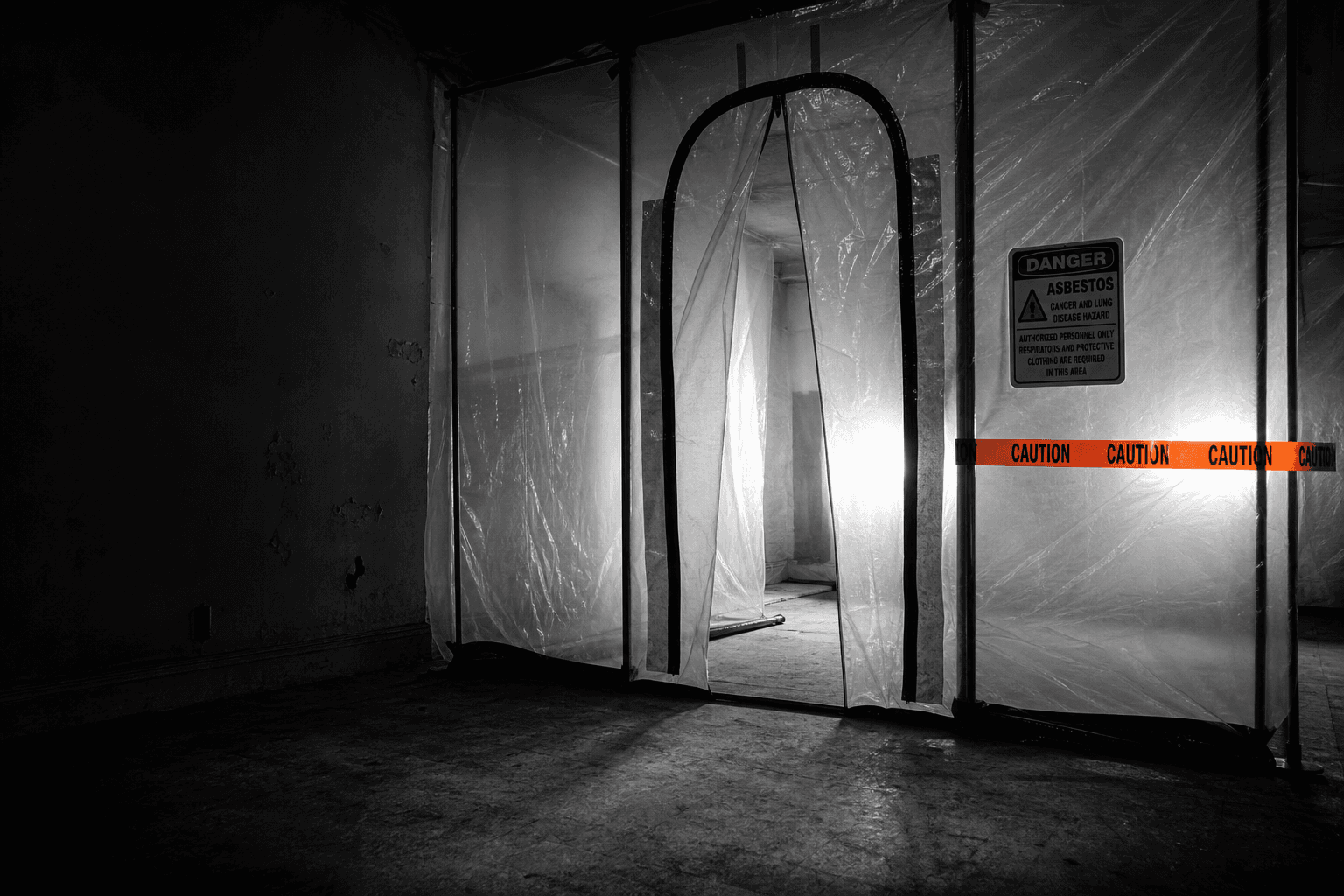
Vermiculite removal is a Type 3 asbestos job — it requires full containment, negative air pressure, HEPA-equipped workers in proper PPE and certified disposal. We set up containment from the attic hatch down, run negative air throughout the removal process, carefully vacuum and bag the material, and HEPA-clean all surfaces before clearance air sampling confirms it's done.
Once it's out, your attic is safe for any work — HVAC upgrades, re-insulation, electrical, storage — whatever you need. A lot of homeowners use the removal as the moment to properly re-insulate with modern spray foam or blown-in fiberglass, which improves their home's energy performance significantly.
If you have a pre-1990 home in Surrey and aren't sure what's in your attic, give us a call. We'll assess it and tell you straight what you're dealing with.